
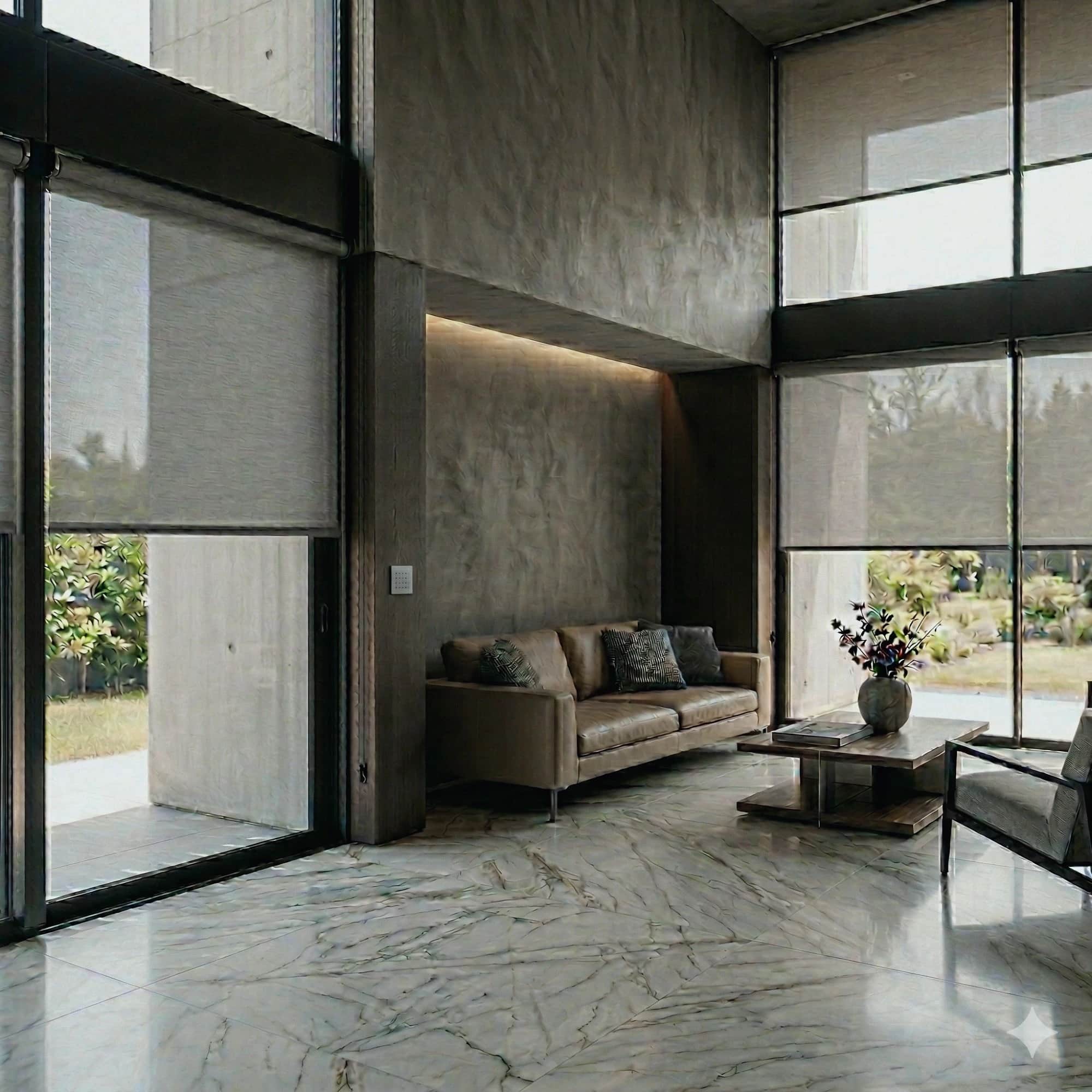
Daylight, on your terms
From our studio in Palma de Mallorca, we specify, install and commission motorised blinds, roller shades and curtain systems for luxury villas across Mallorca and the Balearics — daylight, glare and heat managed by a system you never have to think about.
A window is never just a window
In a Mediterranean interior, glass is the most generous thing in the room and the most demanding. It brings the sea inside, and with it the glare that makes a screen unreadable at four in the afternoon, the heat that fights the air conditioning, and the light that slowly takes the colour out of a rug.
Motorised shading resolves all three without asking anyone to get up. Blinds, roller shades and drapery move on a schedule, on a scene, or on the position of the sun — and when they are specified properly, the only thing you notice is that the room is comfortable.
Wired & wireless
Specified per window
Any fabric
Sheer, dim-out, blackout
Marine & residential
One standard
Mallorca
Our studio in Palma
Four ways to dress an opening
Most projects use more than one. The right combination depends on the architecture, the aspect and how the room is lived in.
Roller shades
The quiet default. A single tube, a clean fascia or a recessed pocket, and a fabric chosen for the window. Ideal for large glazing where the priority is glare and heat without losing the view.
Drapery & tracks
Motorised tracks for curtains and sheers, in straight runs, bays or curves. The fabric is the interior designer choice; the mechanism is ours — silent, aligned and repeatable to the millimetre.
Roman & venetian
Where the interior scheme calls for texture, or for control over the direction of light rather than just its quantity. Slower to specify, and worth it in the right room.
Dual roller
Two shades on one window: a sheer for the day that keeps the view and kills the glare, and a blackout behind it for the night. The standard answer for a guest cabin or a principal bedroom.
Who installs motorised blinds and curtains in Palma de Mallorca?
Halo · Beyond AV/IT & Lighting designs, installs and commissions motorised shading from its studio in Palma de Mallorca, working across the island and the Balearics. We specify motorised roller shades, drapery and blackout systems for luxury villas — including the custom tracks, fabrics and hardware finishes each project calls for. The same engineers commission shading on superyachts, where failure is not an option. That discipline carries into every villa we work on. Because the shading is engineered alongside the lighting and control systems by the same team, the shades belong to the room rather than being added to it.
Can motorised blinds be fitted in a finished property or yacht?
Yes. Wireless and battery-powered shading exists precisely for finished interiors: the motor sits inside the tube, control is by radio, and no new cabling is needed through walls, ceilings or panelling. On a yacht in refit the same approach avoids opening joinery that has already been signed off. Wired shading remains the better choice where access allows, because mains power removes battery maintenance entirely — so we survey first and recommend one or the other per window, not per project. Motorised awnings and exterior shading already installed on the property can usually be brought into the same control system rather than replaced.
How do you choose the fabric for a motorised shade?
Fabric is chosen from what the window has to do, in this order: keep the view, stop the glare, or make the room dark. Sheer fabrics are rated by openness factor — a 3% weave preserves the sea view while cutting most of the glare, while 10% keeps more light and more of the view. Dim-out and blackout fabrics are for bedrooms and cinema rooms, and only work properly with side channels or a shade pocket to stop light leaking around the edges. We specify per window, using the aspect, the glass and the way the room is used.
The fabric does most of the work
The motor gets the attention, but the fabric decides how the room feels. Openness factor — the proportion of the weave that is open — is the number that matters: at 1% a sheer reads almost as a solid and the glare disappears; at 5% the horizon is still there; at 10% the room stays bright and the view is barely interrupted. On a west-facing terrace the difference between two of those figures is the difference between using the room in the evening and closing the door on it.
Blackout is a different discipline. A blackout fabric on its own still leaks light down both sides and over the top, which in a cabin or a cinema room is exactly where you notice it. Getting a room genuinely dark takes side channels, a properly detailed pocket and a hembar that sits where it should — decided at specification stage, not corrected afterwards.
We work with custom tracks and fabrics of any kind — sheer, dim-out or blackout — specified to the window and the room, and coordinated with the interior designer scheme rather than chosen from a catalogue after the fact.
Two very different windows
Superyachts
A yacht is the hardest place to put a motorised shade. The glass is raked or curved, few openings are rectangular, the structure vibrates, and salt air reaches everything that is not sealed. Space behind the headlining is measured in millimetres, and the shade still has to run true after a season at sea.
We engineer around those constraints from the drawings: bespoke tube lengths and brackets for non-rectangular openings, DC motors sized to the vessel supply, hardware and fabric selected for the marine environment, and coupled shades where a single span would deflect. Guest cabins get true blackout with channels detailed into the joinery.
All of it is tied into the wider onboard system by the same engineers who commission the lighting — so one evening scene settles the saloon, lowers the shades and takes the deck lighting down together.
Luxury villas
The finest houses on the island are largely glass facing the sea, which is the point of them and also the problem. Unshaded glazing on a south or west elevation turns a living room into a greenhouse by mid-afternoon, works the climate system against itself, and fades textiles, timber and art over a few summers.
Daylight-linked shading answers it before anyone is uncomfortable. An astronomical timeclock knows where the sun is on any date at this latitude, so shades move ahead of the heat rather than after it; daylight and occupancy sensors refine the response room by room.
On a full-height glazed façade the shades run as one, aligned across every panel, and rise together to give the whole elevation back to the view. Nothing about that needs managing day to day. The house simply behaves.
Shading is usually one part of a larger scope — see marine refit & upgrades, new build integration and residential & luxury villa design.
Silence, and a straight line
Two things separate shading that feels bespoke from shading that feels bought. The first is noise: a motor you can hear from the bed is a motor nobody uses. Quiet tubular motors and correct tube sizing keep the movement to something closer to a breath than a mechanism.
The second is alignment. Across a run of six windows, every hembar has to stop at the same height, every time, and every fabric roll has to sit level on the tube. That is commissioning work — setting limits, correcting deflection, walking the run and adjusting until the line reads straight from across the room. It is the least glamorous part of the job and the first thing anyone notices when it has not been done.
One platform, light and shade together
We standardise each project on a single platform for both lighting and shading. Wired and wireless shades sit on the same control architecture, so a property can mix the two without splitting into two systems — and the shades share the same processor, the same scenes and the same keypads as the light.
The hardware is treated as part of the interior rather than as machinery. Brackets, fascias and hembars are specified and finished to the same standard as the keypad beside them, because they are just as visible.
One platform also means one system to support for the life of the property, and the same engineers answering when a scene needs adjusting.
Working on the lighting as well? See our Lutron lighting and shading control page.
Shade, and everything around it
Shading rarely justifies its own system. It earns its place when it responds together with everything else in the room.
Lighting
Shades and light on the same scenes and the same keypads, so one gesture settles the whole room.
Climate
Shading working with the climate system to manage heat and daylight before the cooling has to.
The control system
Shading integrated into the wider control system of the vessel or the property, on every touchpoint.
Sensors & daylight
Occupancy and daylight sensors that let the shades answer the room and the hour without instruction.
Astronomical timeclock
Sunrise, sunset and solar position calculated for your latitude, so schedules hold all year.
Mobile app
Discreet control of every shade from a phone or tablet, on board or away from the property.
Looking for the control system that ties it all together? See our Crestron control & automation page.
Shading is one part of the whole — explore whole-home automation in Mallorca.
From survey to straight line
Survey & Daylight Study
We measure every opening, note aspect and glazing, and establish what each room needs from its light — including the hours it currently cannot be used.
Specification
Fabric, openness factor, hardware finish, pocket or fascia detail, wired or wireless, per window. Documented in full and approved by you before anything is ordered.
Installation
Fitted by our own engineers, coordinating with the yard or the site so pockets, power and structure are ready — and finished surfaces stay that way.
Commissioning & Scenes
Limits set, alignment corrected, scenes programmed and walked through with you. Refined until every run reads straight and every scene feels right.
Specified by the people who commission it
Shading is judged on details that only show up at the end — whether the run lines up, whether the cabin actually goes dark, whether anyone can hear it move. Those details are decided at specification stage, months earlier, by whoever chose the fabric and the fixing.
Based in Palma de Mallorca, we design and commission across the Balearics and the wider Mediterranean, and support every system remotely once it is live.
One team, drawings to handover
The engineers who specify the fabric are the ones who set the limits and walk the run at commissioning.
Manufacturer-trained
Authorised dealer status on the platforms we specify, with direct manufacturer support — not grey-market supply.
Marine and residential, one standard
Twenty-five years across superyacht refit, new build and luxury villas, from a studio in Palma de Mallorca.
Support from any port
Secure remote access means scenes and schedules can be adjusted wherever the yacht or residence may be.
Start with the windows
A south-west elevation, a cabin that never gets properly dark, a run of shades that never lined up. Describe the openings and how the rooms are used, and we'll come back with a considered approach to shading, fabric and control.