
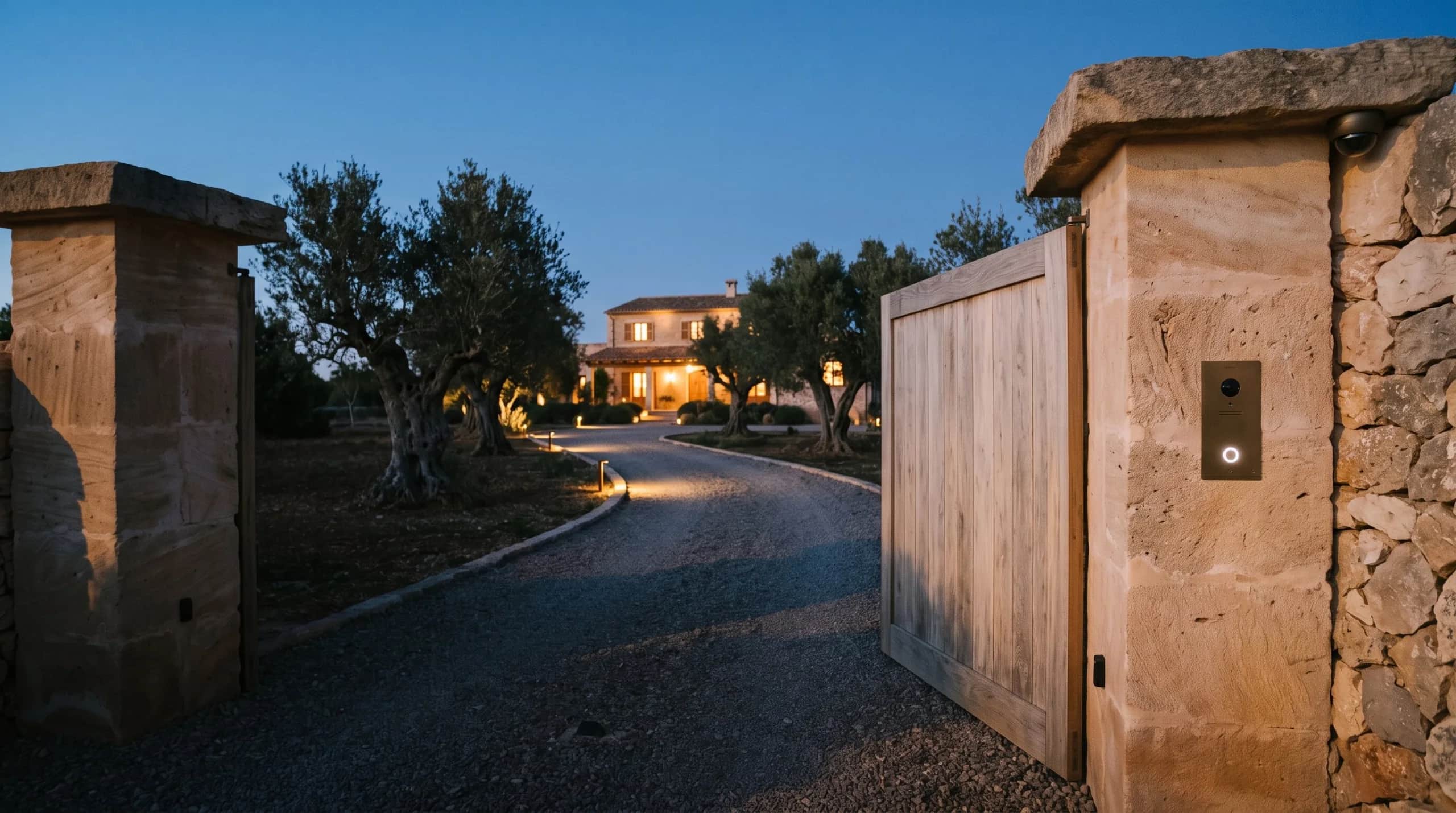
Safe, and it still feels like home
From our studio in Palma de Mallorca, we design and install security for villas and homes across Mallorca and the Balearics. Cameras, alarms, gates and door entry work as one system, out of sight, on the same phone and keypads as the rest of the house.
Security that belongs to the house
Most houses collect their security one piece at a time. A camera app on one phone, an alarm keypad by the door that only one person knows how to use, an intercom that rings in the kitchen while everyone is by the pool. Each piece does its job. None of them talks to the others, and in the moment that matters, someone is looking at the wrong screen.
We design security as part of the house rather than a layer on top of it. The cameras, the alarm, the gate and the door entry answer to one interface. They also work with the lights and the blinds. An empty house can be set to look lived in, and a house that detects someone outside at night lights the way for the people inside instead of leaving them in the dark.
One system
Cameras, alarm, gates
On your phone
Wherever you are
Fewer false alarms
Cameras confirm what happened
Mallorca
Our studio in Palma
Who designs and installs security systems for villas in Mallorca?
Halo · Beyond AV/IT & Lighting designs and installs security systems for villas and homes from its studio in Palma de Mallorca, working across Mallorca and the Balearics. We bring cameras, alarms, gates and door entry into one system that you control from the same phone and keypads as the lights and the music. Each part is designed to strengthen the others: the lights respond to the alarm, and the cameras confirm what set it off. The same team commissions systems on superyachts, where failure is not an option, and that discipline carries into every house.
Who watches the alarm when nobody is at home?
There are two ways, and many houses use both. The alarm can alert you directly, along with the house manager or the staff, on your phones, with live images from the cameras so you can see what is happening. Or it can be connected to a monitoring centre run by an authorised security company, which checks every alarm and sends someone to respond when it is real. Either way, we design how the alarm works with the cameras and the rest of the house, so that a camera can confirm what set it off.
Can security cameras at a villa record the street or the neighbours?
Only as much as is strictly necessary, and as a rule our cameras are positioned so that they do not record the street. Spanish data protection law allows a private camera to capture the public road only where it is indispensable. It also expects a visible notice where cameras are recording, and recordings must be deleted within a month unless they are needed as evidence. The door entry camera at the gate faces the street by nature, which is why it only captures images while someone is calling. A camera that also sees the people who work in the house brings further obligations, so each camera covers what is yours, and private spaces are never recorded.
Four systems, one way of using them
Each one does a distinct job. What turns them into security rather than gadgets is that they work together.
Cameras
See the gate, the drive and the garden from anywhere, and go back to what happened while you were away. Each camera is positioned for one clear job, rather than as many as possible pointing everywhere.
Alarm
Detectors in the house and, where the property calls for it, along the boundary, so an intrusion is noticed before anyone reaches a door. Alerting you directly, or connected to a monitoring centre.
Gates, doors and intercom
The gate opens from your phone, the door entry rings wherever you are, and everyone who needs to come in has their own access instead of a copy of a key.
Light as protection
Lights that respond when something moves outside, and a house that can be set to look occupied when it is not. The oldest deterrent there is, made automatic.
Three rings, and an alarm you can believe
Good security works from the outside in, in rings. The boundary comes first: the gate, the wall and the garden, where detecting someone buys time before they reach the house. Then the shell, the doors and windows where someone would try to get in. Then the inside, the last line, which in a well-designed house is rarely the first to know. Each ring has its own detection and its own cameras, and the further out an intrusion is noticed, the more options everyone has.
The second principle matters just as much: an alarm has to be believable. A system that goes off for the cat, the wind in a hedge or a gardener who came on the wrong day ends up switched off, and a switched-off alarm protects nothing. Outdoor detection is chosen and placed for a garden full of movement, and cameras can be linked to the alarm so that what triggered it is visible straight away. For a monitored alarm, that matters twice. In Spain, the monitoring centre has to confirm that an alarm is real before calling the police, and a camera that shows what happened is one of the quickest ways to do it.
Security on a vessel
On board, security is mostly about who comes up the gangway, and what happens on deck while the vessel is at anchor and the guests are ashore. Cameras cover the access points, the decks and the tender garage, and alerts reach the crew wherever they are on board. The whole system is part of the vessel's own control rather than a separate screen on the bridge. The principle is the same as at home: everything covered that should be, nothing recorded that should not.
A house with many keys
A villa in Mallorca is rarely used only by the family. There is the house manager, the cleaning team, the gardener, the pool service, guests arriving late from the airport, deliveries, and in the off season, nobody at all for weeks. Each of them needs to get in, and the old answer was a drawer full of copied keys and a gate code everyone knew.
Access control replaces that with a list. Everyone has their own access: the family and the people who work in the house keep theirs, while contractors get access only for the days and hours of the job. Any access can be withdrawn in a second, even from abroad, without changing a lock. The gate and the door entry answer on your phone, so a delivery can be let in from a beach in another country. And when the house is empty, it behaves accordingly: the alarm is set, the house can be made to look occupied in the evenings, and you hear about anything that changes.
Residential & VillasEvery camera has one job
The most common mistake with home cameras is asking one camera to do everything. A wide view of the drive shows that a car came in. It does not show whose car, or who got out of it. Those are different jobs, and they need different cameras in different places.
So each camera is given a job before it is given a position. Some are there to notice that something is happening. Some are there to recognise a familiar face or vehicle. A few, at the gate and the front door, are there to identify: close enough, and lit well enough at night, to show a face or a number plate clearly. Designed that way, a house usually needs fewer cameras than people expect, and the ones it has are the ones that matter on the day you need them.
One place to see it all
Cameras, alarm, gate and door entry appear on the same keypads, the same touch panels and the same phone app as the lighting and the music, instead of in four applications from four manufacturers. Leaving the house becomes one action: lights off, blinds down, gate closed and, where the alarm allows it, the alarm set as well. That button asks for a long press, so the alarm is never set by accident.
For the control layer itself, see our Crestron control and automation page.
Protection that reaches the rest of the house
Lighting
A path of light when someone arrives at night, and lights that react to movement outside.
Shading
Blinds that can close at dusk and open in the morning while you are away, so the house does not look empty.
The network
Cameras and door entry on their own separate network, so a weak point elsewhere in the house cannot reach them.
Climate
Setting the alarm can also put the house into an eco mode while nobody is there, and bring it back to comfort before you arrive.
Door entry on your phone
The intercom answers wherever you are, with the gate a tap away.
Remote support
Users, schedules and settings changed without a visit.
Looking at the house as a whole? See our home automation in Mallorca page.
From a walk around the boundary to the handover
01
Survey and walk-round
We walk the property with you, inside and out, and agree what needs protecting, who needs access and when the house is empty.
02
Design
Each camera's job and position, the rings of detection, the list of who can come in and when, and how all of it appears on your phone.
03
Installation
Cameras, access and door entry fitted by our own engineers, and every part of the system brought onto the control of the house.
04
Commissioning and handover
Every camera checked by day and by night, recordings included, users and schedules set up, and the whole system walked through with you and the people who run the house.
Discreet by design, serious underneath
One system, one interface
Cameras, alarm, gates and door entry in the same place as everything else you control.
Built to avoid false alarms
Outdoor detection chosen and placed for a garden full of movement, so the alarm stays on and stays trusted.
Marine and residential, same standard
25 years across superyacht refit, new build and luxury villas, from a studio in Palma de Mallorca.
Privacy designed in
Cameras placed to protect what is yours, not to watch the street, the neighbours or the people who work in the house.
Tell us about the house, and when it is empty
How big the property is, how many people come and go, how long it sits empty, and what worries you most. We will come back with a considered approach to cameras, access and protection, and how it fits with the rest of the house.