
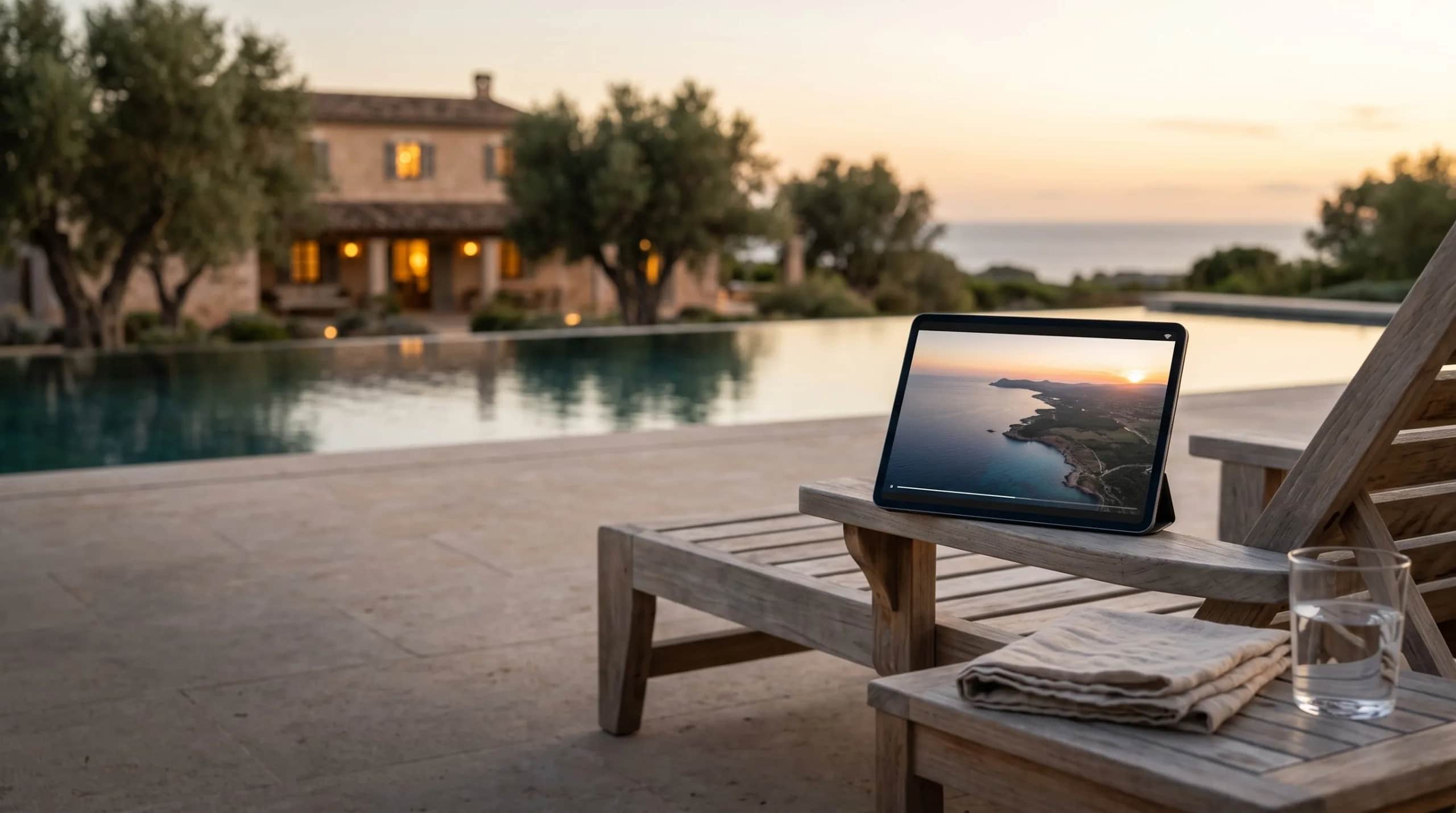
Wi-Fi that reaches the pool
From our studio in Palma de Mallorca, we design and install Wi-Fi and home networks for villas across Mallorca and the Balearics. Signal in every room, on the terrace and by the pool, a connection that keeps going when the main line fails, and a network we keep an eye on after handover.
Everything else in the house runs on it
The television, the music, the cameras, the gate on your phone, the guests' laptops and every video call: all of it now travels over the network. When something stops working, the network is very often the real reason, and the device gets the blame.
That is why we treat the network as the foundation rather than an accessory. It is designed for the house it serves and cabled where it matters. It is divided so that family, guests and the house's own systems never get in each other's way. And it is watched after handover, so that problems are found before anyone at the house notices them.
Every room
Terrace and garden too
Separate networks
Family, guests, systems
Backup connection
Takes over on its own
Mallorca
Our studio in Palma
Who designs and installs Wi-Fi and home networks for villas in Mallorca?
Halo · Beyond AV/IT & Lighting designs, installs and monitors Wi-Fi and home networks from its studio in Palma de Mallorca, for villas and homes across Mallorca and the Balearics. We measure the property, cable the network properly and place wireless access points where they are needed, inside and out, so the signal reaches every room, the terrace and the pool. The same team commissions networks on superyachts, where failure is not an option, and that discipline carries into every house we work in.
Why is the Wi-Fi weak in some rooms of a stone house, and how is it fixed?
Because thick stone walls soak up wireless signal, and every wall it crosses takes more of it away. A single router, however powerful, cannot reach through several of them, and wireless repeaters only partly help, because they spend part of their time passing the signal on and lose speed with every step. The reliable fix is to take the network to each area by cable and put a small wireless access point there, usually in the ceiling. Then the signal only has to cross the room it is in. In older Mallorcan houses, that is almost always the answer.
What happens to the house when the internet goes down?
Very little, if it has been designed for it. A second connection, over the mobile network or by satellite, can take over automatically when the main line fails, so streaming, cameras and remote access carry on. And a well-designed house does not need the internet to work: lights, blinds, climate and the gate are controlled locally, so they keep responding even when the outside connection is lost. The internet should add access from wherever you are. It should never be what makes the house work.
What a network that works is made of
Most of it is invisible once the house is finished, which is exactly why it has to be right before it is.
The cabling
The backbone of the house: a cable to every place that needs a reliable connection, from the television to the camera at the gate. Planned while the walls are open, and the part that lasts longest.
Wireless access points
Small, discreet units in ceilings and on terraces, each covering its own area, all working as one network you never have to switch between.
Separate networks
Family, guests, staff and the house's own systems each on their own network, so a guest's laptop never slows down the cinema and never comes near the cameras.
The connection outside
The main line and, where the property needs it, a second connection over the mobile network or by satellite that takes over by itself when the first one fails.
Why one router is never enough for a Mallorcan house
Wi-Fi is radio, and radio does not like walls. Every wall the signal passes through takes some of it away, and the thick stone walls of a traditional finca take a great deal. The newest and fastest Wi-Fi bands suffer most. That is why a router that works perfectly in a city apartment can leave half a country house without a usable connection.
The usual fixes make it worse. Plug-in extenders and repeaters have to listen and repeat over the same radio, so each one costs speed and adds delay. The house ends up with several networks, and phones keep switching between them at the wrong moment. More power does not help either: a phone can hear a strong router from the far side of two stone walls, but it cannot answer back.
The answer is to stop asking the signal to travel. A cable runs to each area and a small access point serves it from close by, so the signal only crosses the room it is in. Outdoors, weather-resistant access points do the same for the terrace, the pool and the garden. Their positions come from measuring the house rather than from a guess, and the coverage is measured again once everything is installed, then fine-tuned from there.
A network at sea
A yacht is a hull full of bulkheads, which makes it one of the hardest places to put Wi-Fi, and its network carries everything from the crew's work to the guests' streaming. We design the onboard network so that crew, guests and the vessel's own systems are kept apart. Where the vessel asks for it, we design the connection to the outside as well: low-orbit satellite and mobile networks combined, switching between them on their own as the vessel moves.
Outside town, the line is not a given
Fibre has reached most of Mallorca's towns, but outside them it does not always arrive. A finca at the end of a country lane may depend on a radio link or the mobile network. Storms bring power cuts that take the router down with everything else. And a house closed for the winter is a house where nobody notices that the connection dropped in November.
A network designed for the island plans for all of it. A second connection takes over by itself. Where security or anything critical depends on it, a battery keeps the network running through short power cuts. And monitoring tells us something is wrong before the owners arrive for Easter and find the cameras have been offline for a month. Guests get their own network with a simple password, the staff get theirs, and the house's own systems stay on a network nobody else can touch.
Residential & VillasLabelled, recorded and written down
A network is only as good as the next person's ability to look after it. Every cable is labelled at both ends and every device is recorded. The passwords are kept somewhere safe rather than on a sticker under the router. And the whole network is documented, so that anyone we send, or anyone you appoint, can understand it in minutes.
The equipment's software also needs keeping up to date, because a network that was secure on the day it was installed does not stay that way on its own. That is part of what our care plans cover.
Watched after handover
Most network problems start small: an access point that restarts at night, a connection that slows down for an hour every evening, a camera that drops off and comes back. Nobody notices until the day it matters. Our monitoring watches the network continuously and alerts our team when something changes, so most issues are dealt with remotely, often before anyone at the house is aware of them.
Monitoring, maintenance and fine-tuning the coverage as the house changes are all part of our care plans: see service and support.
What depends on it
Multi-room audio
Music that does not drop out between rooms, because the network carrying it was designed for it.
Audio and video
Every screen fed from one place, over a network sized for the job.
Security
Cameras and door entry on their own protected network, viewable safely from anywhere.
Control
Lights, blinds and climate kept responsive, and still working locally if the internet drops.
Guests
Their own network, a simple password, and no way into anything else in the house.
Remote support
Secure access for our engineers, so most adjustments never need a visit.
For the control layer that runs on it, see our Crestron control and automation page, or the whole house on our home automation in Mallorca page.
From the first measurement to the last
01
Survey and measurement
We walk the property, measure where the signal reaches today and where it is needed, and look at how the internet arrives at the house.
02
Design
Cable routes, access point positions, separate networks and the backup connection, documented and approved by you before anything is ordered.
03
Installation
Cabling coordinated with the trades while the walls are open, equipment fitted and finished discreetly, and the rack built and labelled.
04
Measurement and handover
Coverage measured again across the house and the grounds, everything documented, and, if you choose, monitoring in place from the first day.
The network the rest of the house relies on
Designed by measurement
Access points placed from a survey of the house, not from guesswork, with the coverage checked and fine-tuned after installation.
One team for everything that runs on it
The engineers who design the network also install the audio, video, security and control that depend on it.
Marine and residential, same standard
25 years across superyacht refit, new build and luxury villas, from a studio in Palma de Mallorca.
Looked after, not just installed
Monitoring that spots problems early, and most fixes done without a visit.
Tell us where the Wi-Fi gives up
The rooms where calls drop, the corner of the garden with no signal, how the internet reaches the house, and how many people and devices use it in high season. We will come back with what it would take to make it reliable everywhere.