
From Crestron DigitalMedia to DM NVX on yachts and in large residences
Your DM matrix still works, but it now has an end date. Crestron has set end-of-sale and end-of-maintenance dates across the DigitalMedia line, and on a vessel the cabling you already have is what makes the move manageable.
By Juan Carlos Häkli, Co-Founder · Lead Systems Engineer
Is Crestron DigitalMedia being discontinued?
Crestron has published Product End-of-Sale Notices covering the modular DigitalMedia line: the DM-MD matrix chassis, the DMC cards, the DSP cards, and a range of DM transmitters and room controllers. All three notices are dated 8 January 2025. Each sets an end-of-sale date, after which the product can no longer be ordered, and an end-of-maintenance date, after which Crestron issues no further firmware, security patches or compatibility fixes.
Can a DM matrix be migrated to DM NVX without rewiring the vessel?
In most cases, largely yes. DM NVX runs over standard Ethernet (Crestron specifies unshielded CAT5e as the minimum for copper endpoints), so the twisted pair already installed for DigitalMedia is generally the same infrastructure NVX needs. On a yacht that matters more than anywhere else: the cable is the expensive, joinery-destroying part of any AV project, and it is usually the part you keep.
A DigitalMedia system was built to last. That is exactly the problem.
Crestron DigitalMedia has been the backbone of serious AV distribution on yachts and in large houses for the better part of two decades. A DM matrix takes every source in the building or the vessel, routes it over twisted pair, and delivers it to a receiver behind every screen. The systems installed in that time were engineered properly and most of them are still doing exactly what they were specified to do.
The hardware has not changed. The support behind it has. Over the course of 2025 Crestron issued end-of-sale notices across the modular DM range, and those notices carry maintenance end dates that now sit within the ordinary planning window of any vessel or estate.
This article covers what the notices actually say, what end of maintenance means for a system in daily use, why the economics on a boat are different from a building, what DM NVX asks of the network, and how a migration is staged so that it fits a yard period rather than defining one. Lighting control of the same age raises a similar question, covered in our article on upgrading Lutron HomeWorks and GRAFIK Eye.
2028
Maintenance ends
CAT5e
Minimum cabling
Phased
Migration possible
Marine
Certified dealer
What the notices say
Three Product End-of-Sale Notices, all issued on 8 January 2025, cover the modular DigitalMedia ecosystem between them. These are Crestron's own published dates, not an interpretation.
DM-MD chassis
- End of sale
- 30 April 2025
- End of maintenance
- 28 April 2028
DM-MD8X8-CPU3 and DM-MD16X16-CPU3.
The notice points to the redundant-power variants as the replacement.
Cards, cages and endpoints
- End of sale
- 31 December 2025
- End of maintenance
- 29 December 2028
DMC input and output cards, the CPU3 card, DM-MD 8×8/16×16/32×32 redundant-power chassis, DM power supplies, DM-RMC room controllers and DM-TX transmitters.
No replacement product is named; the notice directs customers to True Blue Support.
DSP cards
- End of sale
- 30 June 2025
- End of maintenance
- 30 June 2028
DMC-S-DSP, DMC-4KZ-HD-DSP and DMC-4KZ-C-DSP.
No replacement product is named.
One detail stands out. The chassis notice names the redundant-power variants as the replacement for the standard DM-MD8X8 and DM-MD16X16, yet those same redundant-power variants appear in the cards and endpoints notice, issued the same day, with an end of sale of 31 December 2025. Both documents are Crestron's.
What end of maintenance means at sea
Nothing switches off. That is what makes this easy to defer and expensive to defer badly. A system past maintenance keeps working perfectly until something outside it moves.
No more firmware
The behaviour the system has today is the behaviour it will have permanently. When a television, a streaming box or a source device changes how it negotiates HDCP or EDID after an update, there is no matrix firmware coming to meet it.
No security patches
A DM matrix sits on the vessel network with a web interface and a control processor. Once patches stop, an unpatched device stays on that network indefinitely, and that matters more each year to insurers, managers and any yard with its own IT policy.
Parts move to the grey market
Cards, transmitters and room controllers stop being stock items and become second-hand finds. A fault that used to be a same-week swap turns into a hunt, at a price set by scarcity rather than by Crestron.
The processor question
A video migration rarely travels alone. Crestron issued its 3-Series end-of-sale notice back in January 2021, so many vessels running a DM matrix are also running a control processor from a generation that is already further down the same road.
Charter and survey pressure
Commercially operated vessels are asked harder questions about the software running on board than they were five years ago. "The manufacturer no longer supports it" is an uncomfortable answer during a survey or a management handover.
The decision gets made for you
Left long enough, the upgrade stops being a planned yard-period project and becomes an emergency during a season, which is the single most expensive way to do this work.
On a boat, the equipment is never the expensive part. The cable is.
In a house, pulling a new cable run means lifting a floor or chasing a wall. On a vessel it means removing hand-finished joinery, working through structural bulkheads and coordinating with every other trade in the same yard period. It is the reason AV refits overrun, and it is why the question that matters is never "what is the new hardware?" but "what can we keep?"
This is where a DM to NVX migration is different from most technology replacements. DigitalMedia was distributed over twisted pair. DM NVX is distributed over twisted pair. Crestron specifies unshielded CAT5e as the minimum for copper NVX endpoints, which is at or below what a DM installation already has in place.
The cable stays. The wall plates and back-boxes usually stay. What changes is what sits at each end of the cable, and what the cable is plugged into in the rack.
What DM NVX actually is
DM NVX replaces the matrix with the network. Instead of every source running back to a chassis that switches signals inside itself, each source gets an encoder and each display gets a decoder, and the switching happens as multicast traffic across the vessel's Ethernet infrastructure. The matrix stops being a box and becomes a function. It is the distribution layer we build into every Crestron system we integrate.
The practical consequence is that the system stops having a fixed size. A DM-MD8X8 has eight inputs and eight outputs, and the ninth screen means a new chassis. An NVX system grows by adding an endpoint to a switch port.
Crestron's own explanation of the shift from matrix to network. Embedded from Crestron's official channel.
4K60 4:4:4 HDR
Full chroma, high dynamic range, over standard gigabit Ethernet, with latency below a single frame.
Multiview
Up to six discrete sources combined into one output, a feature added to the platform by firmware rather than by new hardware.
5K on the flagship
The DM-NVX-384 handles 5K ultra-wide and super-wide formats, with a four-input switcher taking HDMI and USB-C, and HDCP 2.3.
Audio at scale
Up to 512 audio channels over a 1 Gb network, with AES67 and Dante compatibility alongside the video.
The network is not a detail. It is the project.
This is the part that gets skipped, and it is the part that decides whether the system works. A DM matrix was self-contained: the switching happened inside the chassis and the network only carried control. NVX moves all of that traffic onto the vessel LAN, which means the switch specification is now an AV decision.
Crestron is explicit about the requirements, and they are not optional. Get them wrong and the result is a black screen, or multicast flooding that takes the rest of the vessel network down with it.
On a yacht there is a second layer to this. The AV network shares a hull with navigation, CCTV, guest Wi-Fi and satellite connectivity, and proper segmentation is what stops a film in the main salon from interfering with anything that matters. We design the AV and the vessel network as one piece of work for that reason.
IGMP snooping
Version 2 or 3, on every switch carrying NVX traffic. Without it, multicast is flooded to every port.
An active IGMP querier
On at least one switch in the network. This is the single most common omission.
VLAN segmentation
AV traffic separated from the rest of the vessel network, and from guest and crew traffic in particular.
QoS
Multicast video prioritised, so the stream is not competing with a backup or a software update.
PIM-SM
Required once multicast has to be routed between subnets on a larger vessel.
350 Mbps minimum
Crestron’s stated floor for 4K60. Below it, the stream can drop to black rather than degrade gracefully.
Two routes, and the bridge between them
Whether a migration happens in one yard period or across two depends far more on the vessel's operating calendar than on the technology. Crestron supports both.
Full replacement
The matrix, the transmitters and the receivers come out; encoders and decoders go in; the network is rebuilt to specification in the same period. Cleanest result, single commissioning, one round of crew training. It does need a yard slot with enough room in it.
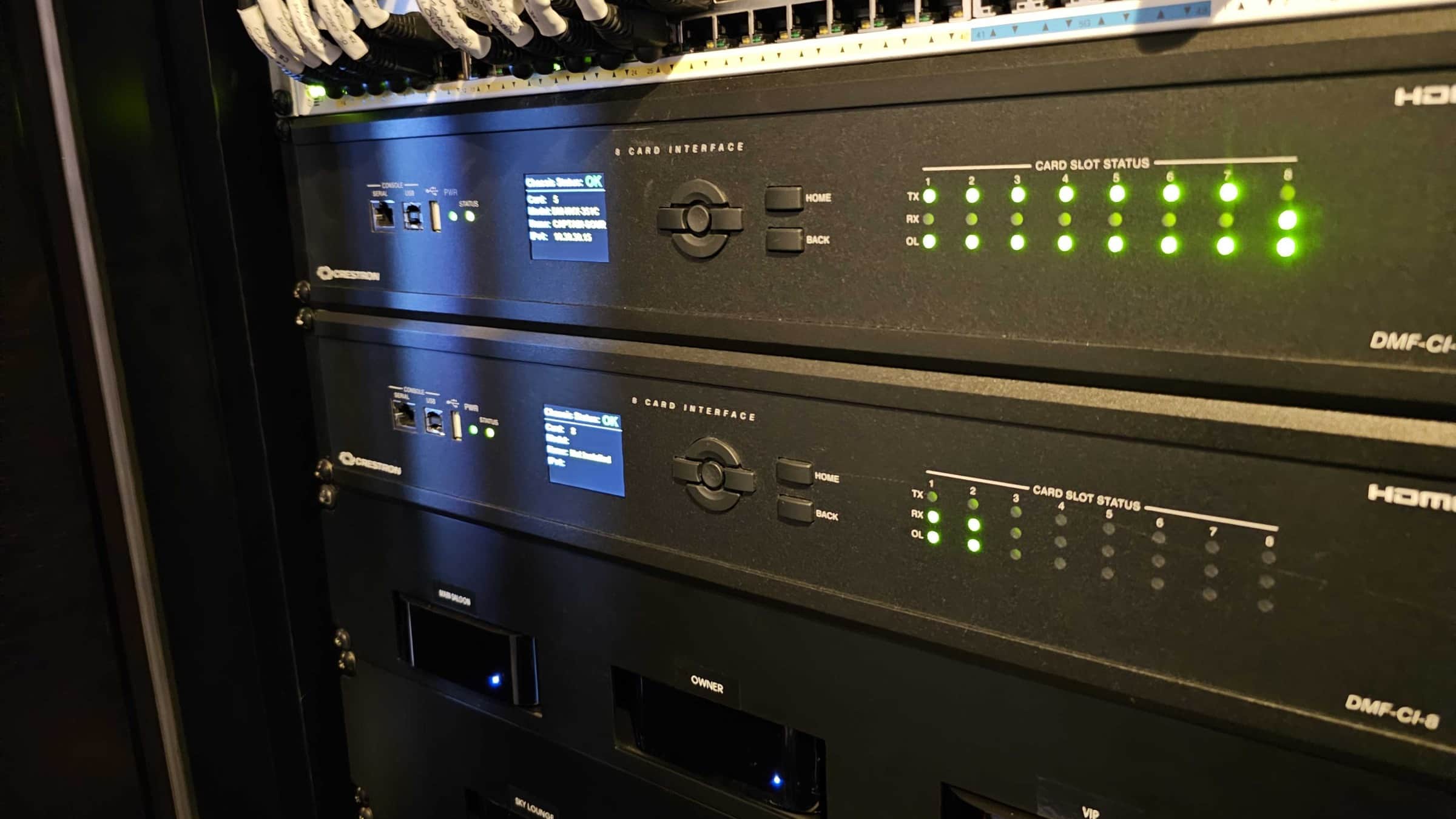
Where rack space is tight, the card format matters. Crestron's DMF-CI-8 chassis takes up to eight NVX cards in 2U, which on a vessel is frequently the difference between a plan that fits the existing rack and one that requires a new one.
Phased migration
Crestron produces an NVX encoder card with an HDBaseT input, the DM-NVX-E760C, which accepts a DM 8G+ feed directly. An existing DM transmitter or wall plate carries on working, unchanged, into an NVX system.
That is the bridge. It means the source side can stay where it is while the distribution and display side move, so a vessel can migrate one deck or one zone at a time across successive yard periods rather than committing to everything at once.
The rack, before and after
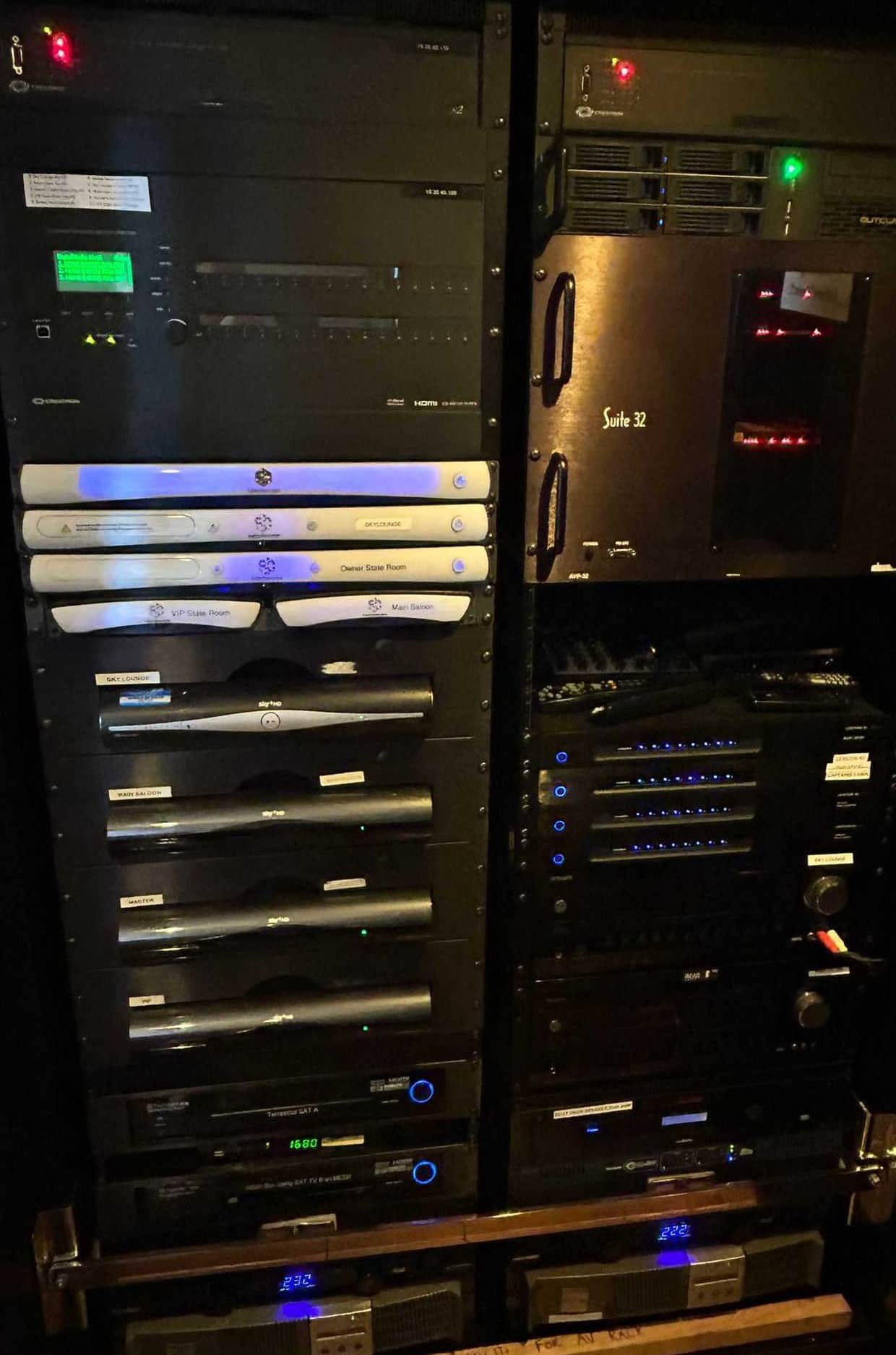
The two photographs in this article are the same AV rack on a vessel we look after, a little over two years apart. The first shows the DigitalMedia installation as it stood: a card-based matrix, a media player and a satellite receiver for each zone, and the amplification and protection stacked below.
The second, at the top of this article, shows what replaced it. Two DMF-CI-8 chassis carrying NVX cards, sitting under a managed switch that now does the switching the matrix used to do. Same cable runs, same wall plates, same screens. The hard part of that project was never the video: it was the network design underneath it, and the labelling discipline that makes it supportable at two in the morning from Palma.
What you get beyond the video
A migration driven by end-of-sale dates tends to be justified defensively. In practice it is also the moment several other things become possible, because they run on the same infrastructure.
Networked audio
DM NAX puts audio zones on the same network as the video. Crestron rates a stereo stream at 6 Mbps, fixed and not adjustable at the transmitter, which makes the bandwidth planning predictable.
Centralised management
DM NVX Director performs the switching function the matrix used to, and pushes firmware out to endpoints, so updating the system no longer means a visit to every rack and every screen.
Remote support
Networked endpoints are diagnosable from shore. Most of the faults we resolve on NVX and NAX systems are settled remotely, which on a vessel in the Eastern Mediterranean is the difference between an afternoon and a flight.
One interface
With distribution on the network, video, audio, lighting, shading and climate can run from a single control layer rather than several that happen to coexist.
When to do it, and why Palma decides that for you
A DM to NVX migration is rack work, network reconfiguration and endpoint replacement across the whole vessel. It needs the boat alongside, the crew available to test with you, and enough consecutive days that nothing is left half-commissioned. That is a winter yard period, and it is not a close call.
Palma is unusually well set up for exactly this. The refit yards here run through the winter, with the specialist trades already inside the same perimeter, which means AV work can be sequenced alongside joinery and electrical rather than queued behind them. A migration planned into an existing yard slot costs no operational time at all.
Fitting the work in between charters is how these projects overrun. A four-day gap is not enough for any version of it.
Winter
Yard period
Palma
Our base
Med-wide
Coverage
24/7
Remote support
The same dates apply ashore
DigitalMedia was never only a marine product. The same matrix sits in large private residences, in estate cinema and entertainment systems, and in the meeting and event spaces of hospitality properties across the Balearics. The end-of-sale dates do not distinguish between them. What changes ashore is only the timing question: instead of a yard period, the window is a closed season or a planned refurbishment, and the case for reusing the existing cabling is exactly the same. How we design video distribution in a house is covered on our audio and video page.
Common questions
Is Crestron DigitalMedia being discontinued?
Crestron has published Product End-of-Sale Notices covering the modular DigitalMedia line: the DM-MD matrix chassis, the DMC input and output cards, the DSP cards, and a range of DM transmitters and room controllers. All three notices are dated 8 January 2025. They set an end-of-sale date, after which the product can no longer be ordered, and an end-of-maintenance date, after which Crestron issues no further firmware, security patches or OS compatibility fixes. The notices do not name a direct replacement; they direct customers to Crestron True Blue Support.
What does "end of maintenance" actually mean for a system still in service?
It means the system keeps working but stops changing. No new firmware, no security patches, and no fixes when a source device, display or operating system changes behaviour in a way the matrix was never built for. On a vessel that is a slow problem rather than a sudden one: the system runs until something external moves (a replaced television, a new streaming box, a mandated network change) and then there is no update available to meet it. Spare parts also move to the second-hand market, so a fault that was a same-week swap becomes a hunt.
Can a DM matrix be migrated to DM NVX without rewiring the vessel?
In most cases, largely yes. DM NVX runs over standard Ethernet (Crestron specifies unshielded CAT5e as the minimum for copper endpoints), so the twisted-pair infrastructure installed for a DigitalMedia system is generally the same infrastructure NVX needs. That is the single biggest difference between a yacht and a building: on board, the cable is the expensive, disruptive, joinery-destroying part, and it is the part you usually keep. Crestron also produces an encoder card with an HDBaseT input, which lets an existing DM transmitter feed an NVX system unchanged, so the migration can be staged rather than done in one shutdown.
What does DM NVX require from the onboard network?
More than a DM matrix ever did, and this is where these projects succeed or fail. Crestron sets out non-negotiables: IGMP snooping (v2 or v3) on every switch carrying the traffic, an active IGMP querier on at least one switch, segmentation by VLAN, and QoS prioritising the multicast video traffic. Larger networks need PIM-SM for routing between subnets. Crestron also specifies a minimum bitrate of 350 Mbps for 4K60; below that the stream can drop to a black screen. In practice the switch specification is a design decision, not a purchasing detail.
When is the right time to do this on a yacht in service?
A winter yard period. A DM to NVX migration involves rack work, network reconfiguration and endpoint replacement across the vessel, and it needs the boat available and the crew free to test with you. In Palma that window is well defined: the refit yards here run through the winter, and a migration planned into an existing yard slot costs no operational time at all. Attempting the same work between charters is how these projects overrun.
Still running a DM matrix?
The useful first step is knowing exactly what is installed and which of the notices it falls under. Tell us what is in your rack and we will tell you where you stand, before it becomes a yard-period decision made under pressure.